Industrial and commercial biomass boilers and heaters provide businesses with a sustainable, cost-effective alternative to fossil fuel heating systems. By converting industrial wood waste into usable heat energy, biomass systems can significantly reduce energy bills, lower waste disposal costs, and help businesses move towards long-term carbon reduction goals.
This guide explains how biomass boilers and heaters work, what fuels they can use, the benefits they offer, typical costs, maintenance requirements, environmental compliance considerations, and how Ranheat designs bespoke systems for reliable, long-term industrial performance across the UK and Europe.
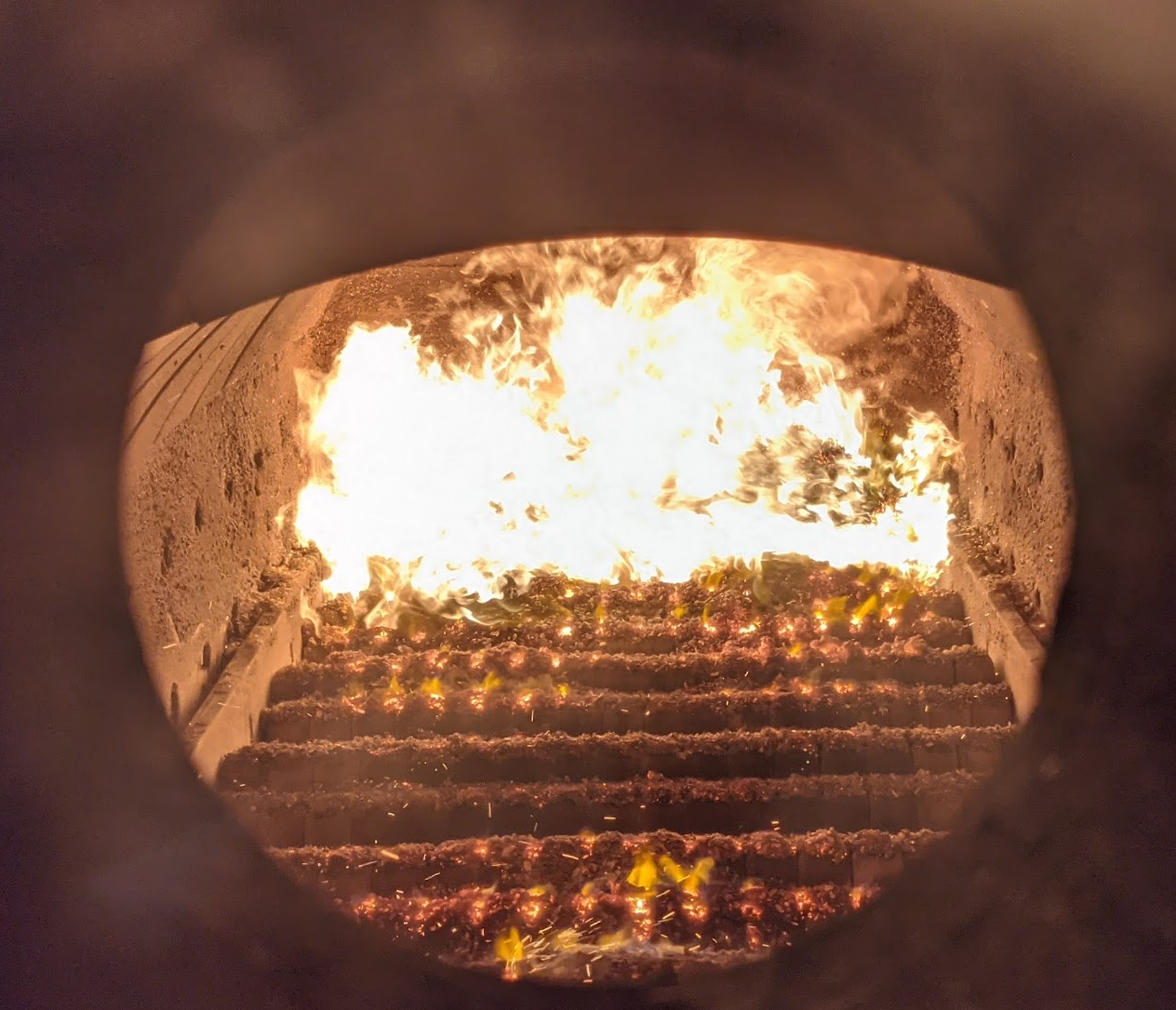
Like any boiler, a biomass boiler burns fuel to provide heat. The important distinction is that the fuel for a biomass boiler comes from biogenic material, harnessing the power of renewable energy and making them a carbon neutral alternative to conventional fossil fuel boilers.
Crucially, Ranheat biomass boilers burn waste as close as possible to where it is produced. This minimises handling and logistics, and ultimately saves time and money that would otherwise be spent on waste disposal. This distinguishes Ranheat from other suppliers of biomass boilers.
At Ranheat we specialise in both Warm Air Heaters (WA range) and Wood Waste Boilers (MSU range). Each range comprises four different models, depending on the amount of biomass input and the required heat output.
There is also the larger M range, and beyond that are bespoke ‘specials’ systems. Specials can include higher levels of power and pressure, other fuels, and different components. These are created on a consultation basis with the customer and can vary hugely.
The wood waste is stored in a silo or bunker, and the system continuously feeds small amounts of the fuel into the combustion chamber. Combustion fans then control the air supply, maintaining the correct air-to-fuel ratio for efficient and clean combustion.
The WA and MSU ranges use the same combustion process, heating air and water respectively.
Ranheat biomass boilers and heaters specifically use industrial wood waste. This includes:
All of these materials contain resins and glues, which some lower-spec systems would not be able to handle. The only restrictions on Ranheat systems are: no heavy metals, and no halogenated organic compounds (such as PVC-type materials, anything containing chlorine or fluorine, and creosote-treated timber).
Ranheat systems are designed to use real-world waste where the material is variable rather than processed to meet a tight specification (such as pellets). We produce specialised boilers for burning wood pellets and wood chips.
Biomass boilers offer a multitude of benefits, ranging from environmental advantages to cost savings and increased energy independence. Here are several reasons why you should consider making the switch.
Using a Ranheat biomass system means that your fuel is often free or actually a negative cost, as it is waste that would be produced regardless and you no longer have to pay to dispose of it offsite. With gas or oil, or even processed wood such as logs, you would be paying for the fuel itself and for transport. So by using your own wood waste as fuel, you are making two savings straight away. Fossil fuels are also likely to become more expensive over time due to their use being increasingly measured and priced, as governments and industries move towards lower and lower carbon emissions.
Ranheat’s biomass boilers use organic materials combined with modern filtration systems such as ceramic filters, which enables them to produce virtually no net carbon dioxide. Choosing biomass means taking a proactive step towards combating climate change and preserving our planet for future generations.
Ranheat boilers are versatile and can be adjusted to a variety of settings and applications. As we offer bespoke solutions, we will always be able to supply the best fit for your specific requirements.
Our advanced technology ensures optimal combustion and heat transfer, thus maximising energy efficiency. With proper maintenance and regular servicing, our products will provide a consistent heating performance decade after decade.
By utilising your own industrial wood waste as fuel for your boiler system, you become less susceptible to volatile global energy prices. At the same time, you can contribute to a more stable and resilient energy infrastructure in the UK and Europe.
Compared to traditional heating methods, biomass boiler systems produce significantly lower levels of pollutants and particulate matter, allowing you to breathe easily and experience the comfort of sustainable heating without compromising air quality.
Demonstrate your dedication to sustainability and corporate responsibility by installing a Ranheat biomass boiler. By choosing a green heating solution, you will not only inspire others, but you will also boost your reputation as an environmentally conscious organisation. This will in turn increase the likelihood that you will attract environmentally aware customers, partners, and stakeholders.
There are many reasons to choose a Ranheat biomass system for your business.
Ranheat is a family business that has been operating for over 30 years. The business originated in Denmark in the 1950s, which is where a lot of the core design philosophy comes from. The Danish business closed in 1990, with the UK operation continuing independently. This means that Ranheat designs, products, and knowledge are not brand new or experimental – they are mature and built on experience and longevity. Continuing family ownership means that you will deal with the same people and the same business for the lifecycle of the system that you purchase. This is not always the case with other suppliers whose business may change over time.
Ranheat systems are designed and built to last. We design systems that will run for at least 15 years, operating continuously. All our products are repairable and we supply any spare parts that are needed. We retain drawings for all our designs, and are committed to supplying new components indefinitely, as well as upgrading systems such as filtration over time. We offer comprehensive service contracts, and our RanheatIO Remote Monitoring system means that any issues can be resolved as quickly and efficiently as possible.
We are committed to designing and building systems that can handle continuous operation, high volumes of material, and potentially harsh conditions. These are robust and durable machines that will remain stable and operational for as long as you need them. The systems are specifically designed so that key components can be removed, replaced, or serviced as needed with minimal downtime. For example, our combustion systems are designed to be replaced within a day to minimise disruption and cost.
The cost of a biomass boiler really depends on the size of the system and the usage requirements. We offer different sizes and types of silos, as well as different types of combustion chambers. As an example, our MSU range typically costs between £40-250k for the boiler itself, depending on the exact specification. We prioritise factory-made silos and storage systems that benefit the customer, and the cost of these varies depending on the size and specifications. Most installations eventually pay for themselves in savings to the cost of wood waste disposal, and reduction in gas and electricity bills.
To get a more accurate picture of how much money you could save by using a Ranheat system, you can use our Industrial Biomass Energy Calculator.
We have years of experience and our team are always happy to advise on our biomass boilers systems – contact them today.
The yearly cost of a biomass boiler really depends on the type and size of the system, what type of heating it is used for, as well as the fuel type and how often the system is used. Another cost to consider is servicing and maintenance. Luckily, at Ranheat we offer lifecycle support and maintenance, and offer annual and weekly service contracts to make sure our boiler systems are running as efficiently as possible for you and your business. We provide a range of support and service contracts to suit any business.
The Renewable Heat Incentive Scheme (RHI Scheme) was a UK government environmental programme designed to increase use of renewable heat sources to reduce emissions and meet the UK’s renewable energy targets. The Department for Energy Security and Net Zero closed this scheme for new applications at the end of March 2021 (or March 2023 in some specific circumstances). Accredited installations made prior to that date will continue to receive quarterly payments for up to 20 years, as long as the installation is maintained in line with the original RHI contract.
It is sometimes possible to get local authority grants or regional funding schemes for biomass heating systems, though this is dependent on the location and the system.
Investigate the Numbers
The numbers add up…
Concerned about costs and efficiency? We provide free, bespoke quotes for any type of business that produces wood waste across the industrial, commercial, community, and leisure sectors. Get in touch today for more information and a free no-obligation quote.